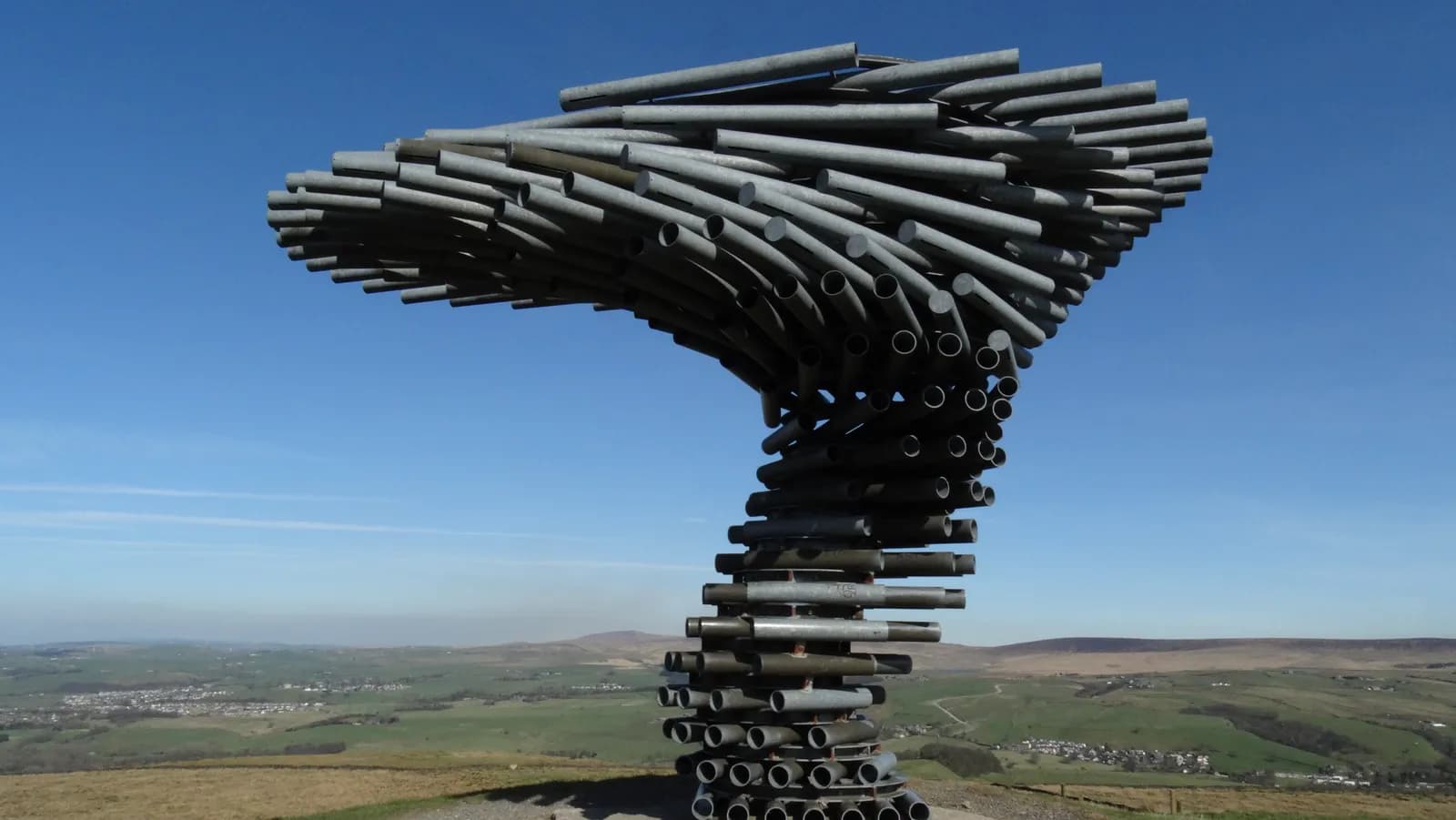
Perched high on Crown Point above Burnley, the Singing Ringing Tree has become one of Lancashire's most distinctive landmarks since its completion in 2006. This three-metre wind-powered sound sculpture transforms the Pennine breeze into an ever-changing choral composition that draws visitors from across the region.
Design and Construction
The sculpture was designed by architects Mike Tonkin and Anna Liu of Tonkin Liu, working with structural engineer Jane Wernick Associates and fabricator Mike Smith Studio. Constructed from galvanised steel pipes arranged in stacked layers, the structure resembles a windswept tree standing against the elements. Each layer is rotated 15 degrees relative to the one below, allowing the sculpture to respond to wind from varying directions.
Some pipes serve a purely structural and visual purpose, whilst others are cut across their width to enable sound production. Holes added to the underside of each pipe allow for precise tuning, with different lengths producing different chords. The result is what the designers describe as "a slightly discordant and penetrating choral sound covering a range of several octaves."
Public Selection and Launch
The design was selected in early 2005 following public consultation across Burnley. Three designs were exhibited in six venues around the borough, and the Singing Ringing Tree was unanimously chosen by local residents. The £150,000 sculpture was officially launched on 14 December 2006 by the Mayor of Burnley, Councillor Mohammad Najib JP, together with designers Mike Tonkin and Anna Liu.
The site at Crown Point previously contained a brick shed and two radio masts that were described as an eyesore. During construction, the top half of the shed was demolished and the rubble used as hard core for a concrete base. The mound was then covered with soil and turf, and new fenced paths were created through the boggy landscape to improve accessibility.
Awards and Recognition
The Singing Ringing Tree has garnered significant recognition within the architecture and design community. In 2007 it received a RIBA National Award, one of just 14 winners that year, alongside a RIBA Northwest Award. It was also shortlisted for the Stephen Lawrence Award in 2007 and received a Certificate of Merit at the Structural Steel Design Awards in 2008. In 2015, The Independent described it as a "British Landmark for the 21st century."
Part of the Panopticons Project
The sculpture forms part of the Panopticons, a series of four large-scale outdoor sculptures commissioned by the East Lancashire Environmental Arts Network (ELEAN) and managed by Mid Pennine Arts. The project's aim was to erect a series of 21st-century landmarks across East Lancashire as symbols of the area's renaissance.
The Panopticons project involved over 22,700 local people, 47 schools, 366 teachers, 46 community organisations, and more than 100 volunteers. It employed 139 artists and architects, and generated 208 construction jobs. The sculptures were designed to draw city residents into the countryside and provide places from which the public can enjoy the landscape.
A Musical Experience
The sculpture's acoustic properties make each visit unique. As the designers note, "each time you sit under the tree you will hear a different song." The prevailing Pennine winds determine the volume and character of the sound, creating an experience that shifts with the weather and seasons.
The sculpture attracts families and friends who journey specifically to hear the tree sing. Its status as a "musical sculpture" sets it apart from conventional public art, offering visitors an immersive sensory experience that combines visual impact with auditory surprise.
Views and Accessibility
From Crown Point, visitors are treated to panoramic views across East Lancashire. Pendle Hill rises to the north, whilst the Cliviger wind turbines are visible to the east. The outlook encompasses Burnley itself, including Turf Moor football stadium. On clear days, the view extends to the Bowland Fells, Pendle, Ingleborough, Pen-y-ghent, and Great Whernside.
The site is accessible via fenced paths that wind through the surrounding landscape. The installation is unlisted but appears in the Borough of Burnley's list of notable buildings and structures.
Legacy and International Reach
The success of Burnley's Singing Ringing Tree has inspired two similar installations in the United States: one near Austin, Texas, installed in March 2017, and another in Abilene, Texas, donated in July 2022. However, neither matches the original Crown Point sculpture, which remains a defining symbol of Burnley's creative regeneration and commitment to public art.
For Burnley residents and visitors alike, the Singing Ringing Tree offers a distinctive experience where engineering, art, and nature converge to create something truly unique to this corner of Lancashire.